
Can Ohio Schools Use 12-Passenger Vans? What HB 54 Changed, and What It Didn’t
Ohio now lets districts run vans built for up to 12 passengers. Federal sale rules and rollover risk haven't moved. Here's what that means for your fleet.
In this article ▾
Key takeaways
- Since June 30, 2025, Ohio lets school districts use vehicles factory-built for 12 or fewer passengers, with conditions.
- Federal law still bars any dealer from selling a new 12-passenger van for student transport. State law can’t change that.
- Our default: a van built for 9 passengers plus the driver. It stays under the federal school bus line, and the driver doesn’t need a CDL.
- Have a CDL driver? Then an MFSAB is the safest choice for 10 or more students on activity trips. Ohio requires MFSAB drivers to hold a CDL.
- If a 12-passenger van is truly your only option, start with our summary of the main rules and confirm them with the state.
Download the one-page guidePDF · share it with your board or transportation team
Since Ohio’s House Bill 54 took effect, transportation directors, principals and charter school operators keep asking us the same question: “Can we use a 12-passenger van for students now?”
Ohio law now allows it in some cases. But federal law still bars any dealer from selling you a new one for student transport, and the van’s rollover risk hasn’t changed. Here’s the detail, our recommendation, and a summary of the main rules if you decide to use one anyway.
This article replaces our January 2026 post on HB 54, written while the bill was still being debated.
What Ohio’s HB 54 changed
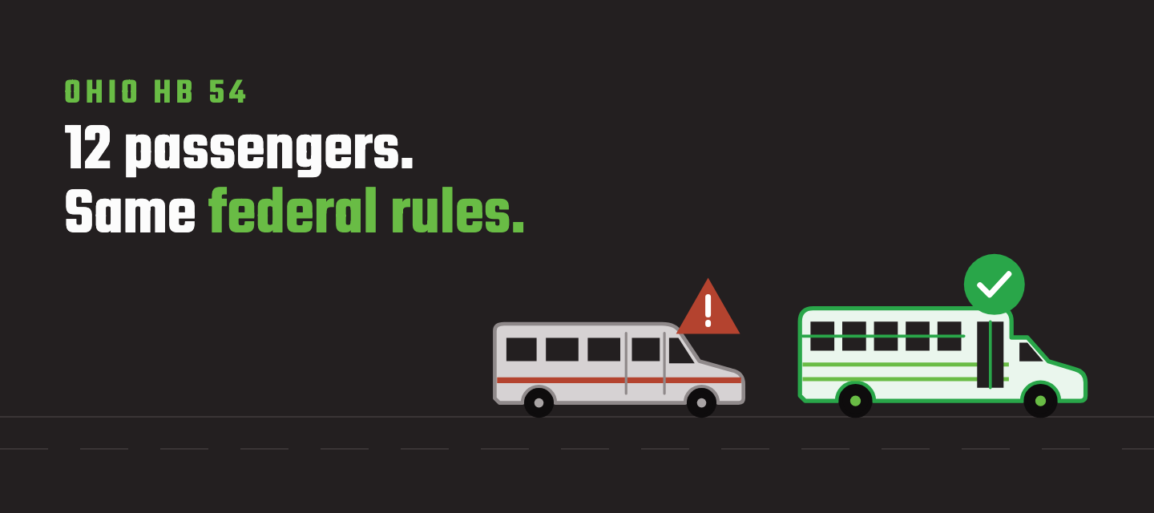
HB 54 took effect June 30, 2025. It amended Ohio Revised Code 4511.76 to allow an “alternative vehicle,” one “originally manufactured and designed for not more than twelve passengers,” not counting the driver. The old limit was nine.
- School districts may own, operate or contract for these vehicles for school, activities and school-sanctioned events.
- Chartered nonpublic and community schools may use them only under specific conditions, listed in the checklist below.
The law also sets rules for inspection, drivers, loading and restraints. We’ve summarized the main ones in a checklist at the end of this article.
What HB 54 didn’t change: federal law
Under federal law, a vehicle designed for more than 10 people, driver included, that will be used significantly to transport students is a school bus. A 12-passenger van fits that definition.
Federal law (49 U.S.C. 30112) requires anyone selling or leasing a new vehicle to make sure it meets the safety standards for its use. Conventional 12- and 15-passenger vans aren’t certified to school bus standards, so:
- No dealer, including BSI, can legally sell or lease you a new 12-passenger van for students.
- NHTSA says a school that buys or leases one new can face civil penalties too.
Ohio’s law governs how schools operate vehicles. It doesn’t override federal rules on selling them. Those federal sale rules apply to new vehicles, which is why a used van may be an option under Ohio law.
The safety picture
Large passenger vans have a long record of rollover risk, and the risk climbs as they fill up.
~3×
Rollover risk with 10+ occupants vs. fewer than 10 (NHTSA, 15-passenger vans)
~5×
Fully loaded vs. driver only, in a later NHTSA analysis
50+
MPH, where NHTSA found the risk rises sharply, along with curves
A full load raises the center of gravity and shifts it rearward, so a sudden swerve is harder to control. Athletic teams with gear make it worse. Ohio’s own guidance warns about this.
To be fair, electronic stability control has been standard on new vans for over a decade and has cut rollover crashes. Most of the research covers 15-passenger vans, and 12-passenger vans carry less weight. They’re still not built to school bus crash standards: no compartmentalized seating, no school bus rollover protection, no joint-strength requirements.
“Should be avoided except when completely necessary.”
NASDPTS 2025 position paper on alternative transportation, cited in Ohio’s HB 54 guidance
What we recommend
Our recommendation
Start with a van built for 9 passengers plus the driver. If you have a CDL driver who’s willing and able to drive it, a Multifunction School Activity Bus (MFSAB) is the safest choice for 10 or more students on activity trips.
Why a 9-passenger van is our default
- It’s under the federal school bus line. Nine passengers plus the driver is 10 people, so the van isn’t a school bus under federal law and we can legally sell you a new one.
- Your staff can drive it. The driver must meet Ohio’s motor van driver requirements (ORC 3327.10 and the state’s pupil transportation rules), but no CDL is required.
When an MFSAB makes sense
- It needs a CDL driver. Since September 30, 2025, Ohio treats MFSAB drivers as school bus drivers (ORC 3327.10(M)). The Ohio Department of Education and Workforce says that means a CDL for every MFSAB driver, with school bus and passenger endorsements, plus the full school bus driver qualifications. That applies to 14-passenger models too, even though federal rules wouldn’t require a CDL for them.
- It complies with federal law. An MFSAB meets the federal school bus safety standards, except for the flashing lights and stop arm, so we can legally sell you a new one for student transport.
- It protects students in a rollover. MFSABs are built to school bus standards for roof strength, body joint strength and compartmentalized seating. Vans aren’t.
| Students per trip | What to use |
|---|---|
| 9 or fewer | A 9-passenger van or a minivan, including accessible vans. Our default. With the driver, that’s 10 people or fewer, under the federal school bus line, and no CDL is needed. |
| 10 or more: field trips, athletics, activities | An MFSAB, if you have a CDL driver. Ohio requires a CDL for every MFSAB driver. Without one, split the group across 9-passenger vans. |
| 10 or more: daily home-to-school routes | A school bus. MFSABs can’t run regular routes in Ohio; HB 96 limits them to non-routine trips. |
If you must use a 12-passenger van
We don’t recommend it. But if a 12-passenger van is your only option, here are the main requirements in Ohio and federal law that we know of, plus the safety steps Ohio and NHTSA recommend for large vans.
Before you rely on this list
This is a summary, not a complete list of every rule that applies to your school. Rules change, and some details live in state regulations we haven’t reproduced here. Confirm the current requirements with the Ohio Department of Education and Workforce, Office of Pupil Transportation, before you buy or use a van for students.
Before you buy
- Buy used, not new. Federal law bars any dealer from selling or leasing a new van for student transport, and a school that buys one new can face penalties. That rule applies to new vehicles. Under federal law, a van generally stays “new” until its first sale to someone who bought it to use, not to resell. A low-mileage or dealer-demo van that has never had that first retail sale may still count as new, so confirm the van’s sale history before you buy.
- Check the factory rating. The capacity label must show 12 or fewer passengers, not counting the driver. Removing seats from a larger van doesn’t count; only the manufacturer can change the rating. If the van has wheelchair positions, check the label before you buy.
- Confirm your school is eligible. School districts may use these vehicles. Chartered nonpublic and community schools may use them only if one of these applies: the student’s home district has declared transportation impractical; the student lives more than 30 minutes from the school and the district isn’t required to transport them; or your governing authority has offered to provide the transportation in place of the district.
- Talk to your insurer. Coverage terms for large vans vary, and some carriers restrict them.
On every trip
- Use a qualified driver. The driver must meet Ohio’s school bus or motor van driver requirements (ORC 3327.10 and the state’s pupil transportation rules), hold a valid license and be experienced with this vehicle. A CDL isn’t required.
- Load and unload off the road. The van has no warning lights or stop arm, so it can never stop on the roadway to pick up or drop off students.
- Buckle everyone in. Every rider uses a seat belt, and younger children ride in the child restraint that fits their age, height and weight.
- Check the tires before you leave. Look at pressure and tread before each trip, spare included. On a used van, check the tires’ age too; they age even when unused.
- Don’t overload it. Keep gear ahead of the rear axle and nothing on the roof. If the van isn’t full, seat riders ahead of the rear axle, filling from the front.
Throughout the year
- Inspect it twice a year. A qualified mechanic must inspect the van at least twice a year and confirm it’s safe for pupil transportation.
- Meet Ohio’s vehicle rules. Follow the vehicle and signage requirements in Ohio Administrative Code 3301-83-19, and check with the Ohio Department of Education and Workforce if you’re unsure.
These are Ohio’s rules. Other states differ, and several, including Illinois, Missouri, Minnesota and Florida, don’t allow 12-passenger vans for students at all. This article isn’t legal advice. Before changing how you transport students, check with the Ohio Department of Education and Workforce, Office of Pupil Transportation, and your counsel.
Sources
- Ohio Revised Code 4511.76 (effective June 30, 2025)
- Ohio DEW: Use of Vehicles Other Than School Buses for Pupil Transportation
- Ohio DEW: Multifunction School Activity Buses (Office of Pupil Transportation, Fall 2025)
- NASDPTS 2025 Alternative Transportation Position Paper
- NHTSA: School Bus Regulations FAQs
- NHTSA: Definition of Multifunction School Activity Bus (2003)
- NHTSA: 15-Passenger Vans (safety recommendations)
- NTSB: Evaluation of the Rollover Propensity of 15-Passenger Vans
Not Sure What Fits the Rules?
Tell us your riders and routes. We'll recommend a compliant vehicle.